Mahamudra & Dzogchen
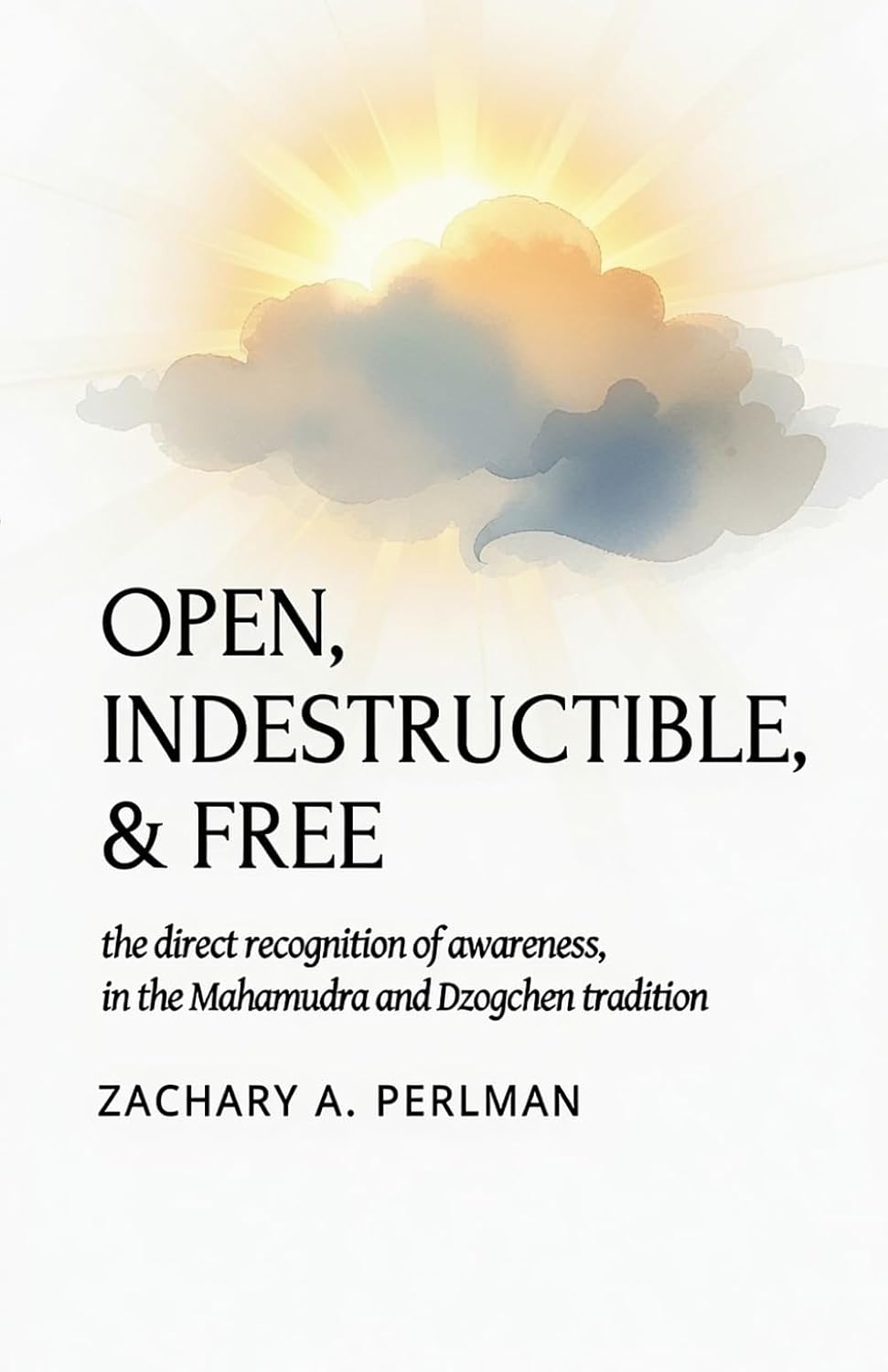
Open, Indestructible, & Free
The Direct Recognition Of Awareness In The Mahamudra And Dzogchen Traditions
Questions about the book? Write to me.
About The Book
For a thousand years, the Mahamudra and Dzogchen traditions of Tibet have carried a claim so plain it is easy to miss: the awareness reading this sentence is already open, already unbreakable, already free. Nothing needs to be built. Nothing needs to be earned. What is needed is clear seeing.
Open, Indestructible, & Free is a companion for the person who suspects that claim might be true and has no idea where to stand to test it. It sets aside the graduated path, the years of preliminaries, and the requirement of formal authorization, and it points directly instead, at the nature of awareness, now, in your own present experience.
What This Book Does
It turns you toward looking, in a chapter on why this matters now, in a life shaped by speed and noise and a background hum of dread. It shows you what to look at, in a sequence of direct experiments you perform rather than read, drawn from the pointing-out instructions at the heart of both traditions. It teaches you how to return, because the glimpse is not the point. The return is. Recognition that cannot survive traffic and grief and email is a mood, not a realization.
The book is built as a circle you can enter at any point and walk as many times as you need. It is also honest about its own limits. This is a companion, not a transmission. It cannot see you, and it cannot confirm what a living teacher can. What it can do is bring you to the threshold, in plain modern English, without asking you to first become someone else.
For readers of Mingyur Rinpoche, Tsoknyi Rinpoche, Loch Kelly, Adyashanti, Rupert Spira, and Sam Harris, and for anyone who has read about awakening for years and never once been told exactly where to look.
Appearances are mind. Mind is empty. Emptiness is spontaneous presence. Spontaneous presence is self-liberating.
From The Book
Look For The Looker
Being Shown What Was Never Hidden
Something is aware. So look for it.
Turn attention back on itself. The awareness that is reading these words, that is knowing this exact moment: look directly at it. Do not think about it. Look for it. Look for the one who is aware. Look for the looker, the seer, the knower, the someone who seems so obviously to be here, behind the eyes, doing the being-aware.
Do it now, actually, before the next sentence. Turn around and look for the awareness itself.
What do you find?
Look carefully, and honestly, and you find no thing. No object, no shape, no color, no location, no one standing there to be caught hold of. You will find the sensation of the eyes, perhaps, or a vague sense of somewhere behind the face, but look for the actual one who is aware, the self at the center, and there is no such thing to be found. There is no small solid someone in there. And yet, and this is the whole point, looking is still happening. Knowing is still fully present. Awareness is unmistakably here and completely unfindable at the same time. It is not that you failed to look hard enough. It is that there was never an object there to find.
Now watch for a very subtle move, because it will almost certainly happen. When the search for a looker comes up empty, something in you wants to quietly reinstall a someone: a witness who stands back and calmly observes that there is no one here. That witness is just the self, sneaking back in through a side door, now dressed as the one who notices the absence. So look for that witness too. Turn and look directly for the one who is aware that there is no self. It is not there either. There is knowing, vivid and undeniable, and no one behind it. That absence of anyone, with knowing still completely present, is not a lack and not a loss. It is the openness you were looking for all along, and it was never going to be an object you could hold.
The Catalog
Other Books
Nine more titles on recognition, integration, and the traditions that point at what is already here.