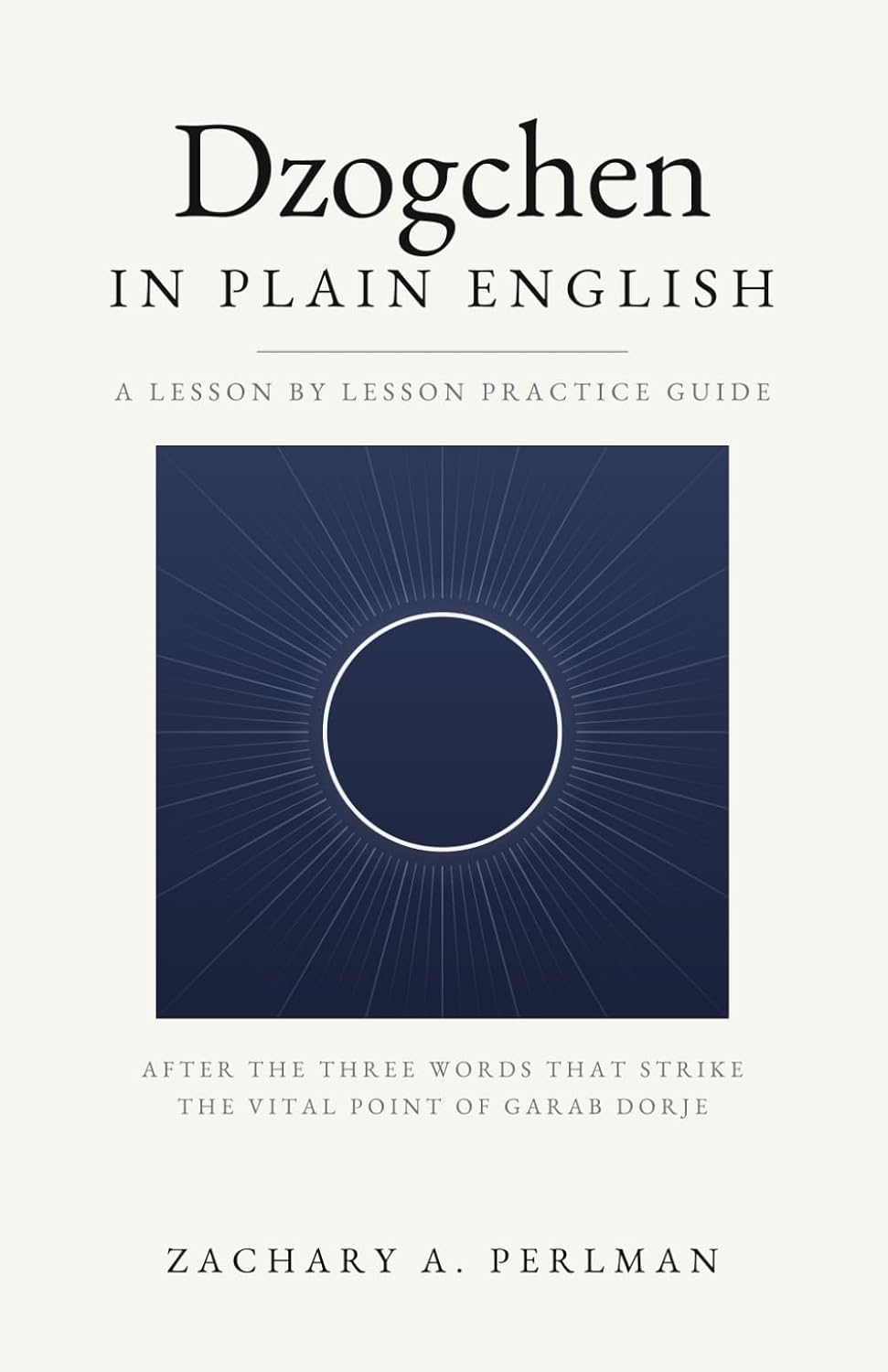
Dzogchen
Dzogchen In Plain English
A Beginner's Guide To Self-Liberation
Questions about the book? Write to me.
About The Book
Pure from the very beginning, not made pure by anything. Spontaneously present, not manufactured by anyone. This, just as it is, is your own awareness.
Dzogchen, the great completeness, is the summit of the Nyingma tradition and the plainest teaching it has. Its root instruction is three sentences long. Garab Dorje left them as his final testament, and Patrul Rinpoche's commentary on them is the tradition's best loved short text. The literature that surrounds those three sentences is vast, technical, and written for people who already have a teacher standing beside them.
This book walks the path those three sentences describe, lesson by lesson, in language a modern reader can hear.
What You Will Practice
- The four thoughts that turn the mind, the special preliminaries, and guru yoga
- Rushen, which separates the ordinary mind from awareness by searching for the mind and failing to find it
- Posture, the open gaze, and resting in natural stillness
- Semdzin, the short techniques that settle the mind or cut the flow of thought
- The ground: essence, nature, and energy, primordial purity and spontaneous presence
- Telling rigpa from sem, which is the distinction the whole path turns on
- The three words: direct introduction, deciding upon one thing, and confidence in liberation
- Trekcho, cutting through, and the four ways of leaving things just as they are
- Carrying recognition into daily life, sleep, and dying
- The three meditative experiences, and the strayings that imitate realization
How Each Lesson Works
Twenty lessons across six modules. Each one gives you something to read, something to contemplate, and something to sit with, so that studying the path and walking it stay close together. A glossary of terms is included for the Tibetan vocabulary the tradition uses.
Who It Is For
For anyone drawn to look directly at their own experience. You do not need to be a Buddhist, to have taken any vow, or to belong to any lineage. It is meant to serve a beginner arranging a cushion and a longtime practitioner returning to first things alike.
From The Book
Telling Awareness From The Ordinary Mind
Lesson Eleven
Orientation
Everything in Dzogchen comes down to one distinction. Sem is the ordinary mind, moving, grasping, dividing. Rigpa is awareness, the knowing that is not divided. They are not two substances and not two places. They are one situation seen with and without a split down the middle, and learning to tell them apart from the inside is not preliminary to the path; it is the path.
The Teaching
The ordinary mind always has a structure: something knowing and something known, a here and a there, a subject positioned across from an object. Everything it does depends on that structure, including its meditation. It arises, it moves, it ceases, it prefers, it compares, and it is never at rest for long because a split is inherently unstable. It is not the enemy and it is not the wrong thing to have. It is simply not what the tradition is pointing at.
Awareness has no such structure. It knows, but there is no knower standing at one end of the knowing and no object at the other. It does not arise, because it was not absent, and it does not cease, because there is nothing in it to run out. It is not a better, quieter, more spiritual version of the ordinary mind; it is what the ordinary mind is made of, in the way that a wave is not a better version of water. And here is the part that makes the distinction so hard to catch: awareness is not somewhere else during the ordinary mind's activity. Every thought is occurring within it and made of it. The problem was never that awareness was missing. The problem is that it is too close, too constant, and too much the thing doing the looking to show up as something looked at.
This is why the classic instructions are all variations of turning around rather than going deeper. You are not being asked to find something subtle. You are being asked to notice what is already obvious and has been obvious the entire time, which is a much stranger request and much harder to comply with. The practices in the rest of this book are, without exception, tricks for interrupting the search long enough for the searcher to be seen.
What To Watch For
The mind will offer you an answer, usually a good one, and the answer will be a thought about awareness rather than awareness. Notice how satisfying the answer is and let it go anyway. The other error is to conclude that since nothing is found, nothing is there. Something is very clearly there; it simply is not a thing. Sit with that discomfort rather than resolving it in either direction.
The Catalog
Other Books
Nine more titles on recognition, integration, and the traditions that point at what is already here.