Comparative Study
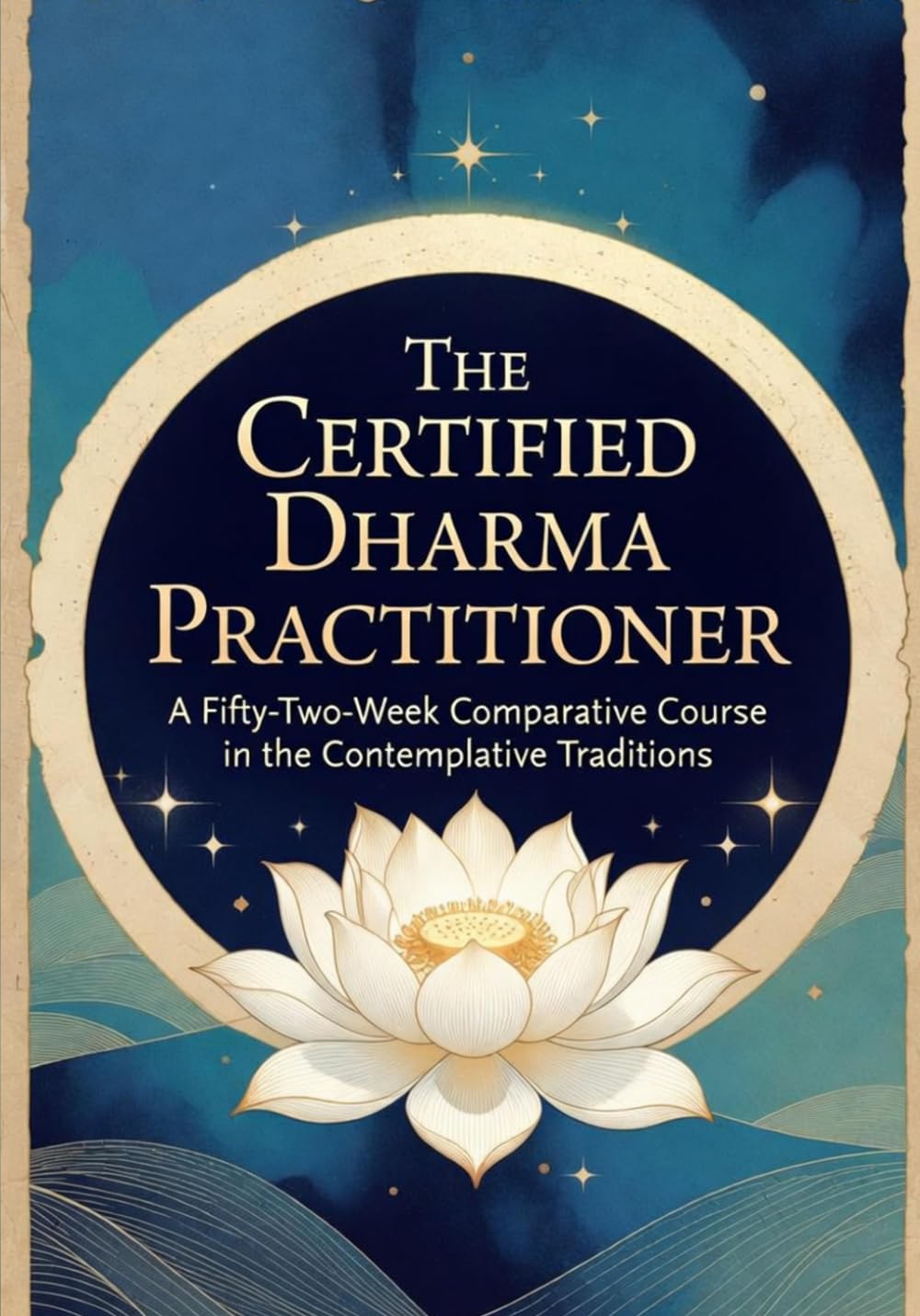
The Certified Dharma Practitioner
A Fifty-Two-Week Comparative Course
Questions about the book? Write to me.
About The Book
Fifty-two weeks. One honest path through the world's great contemplative traditions.
There is no shortage of books on Hindu and Buddhist thought. What has been missing is a single, serious, self-guided course, comparative rather than sectarian, precise rather than watered down, built so that a year of steady attention adds up to something lasting.
The Certified Dharma Practitioner is that course. Across twelve monthly modules it sets Hindu dharma beside Buddhist dhamma, the one Self of Advaita beside the teaching of no-self, the world as maya beside the world as divine play. It refuses to dissolve those differences into a comfortable haze of oneness. You are trusted to sit with real disagreements, named plainly, rather than have them resolved for you.
Every week brings cited passages from the primary texts (the Bhagavad Gita, the Dhammapada, the Upanishads, the great Mahayana sutras) in fresh renderings, each followed by questions for reflection and a contemplative practice with room to write.
Inside The Year
- Twelve modules of four lessons each, with four integration weeks at the quarter turns
- Primary sources in fresh translation, each with commentary
- “Where the traditions diverge”: the honest differences most introductions smooth over
- Weekly reflection prompts and guided practice, with journaling space throughout
- A complete master glossary, annotated bibliography, and index
No teacher down the hall. No enrollment. No group to keep pace with. Only the book, something to write with, and a year to let it change you.
From The Book
Where The Traditions Actually Diverge
Week Eleven, Ego And The False Self
Press the one question on both: the ego falls away; what remains?
Vedānta answers: a Self remains. Strip off the ahaṃkāra and the changing inner instruments and you do not arrive at nothing. You arrive at the witness, sākṣin, pure awareness, which is ātman, which is Brahman, infinite and unchanging, your real identity. The self-project ends in a deeper, truer Self.
Buddhism answers: no self remains to be found. Strip off the aggregates and you find only more aggregates, and then their ceasing. There is no witness-Self hiding behind consciousness, because consciousness too is on the list of what is not-self. The self-project ends not in a truer Self but in the release of the search for one, and that release is liberation.
This is not a subtle difference of emphasis. It is the exact point at which one tradition's deepest claim is the other's named error. The Vedāntic sākṣin, unchanging self-luminous awareness held to be one's true identity, is precisely what the Anattalakkhaṇa Sutta appears built to deny when it places viññāṇa among the not-self. So the gentle, near-universal-sounding teaching, "you are the awareness behind your thoughts, rest as that," is not a neutral meeting-ground of all traditions. It is a Vedāntic answer. Buddhism heard that answer, understood it, and declined it. To present "you are the witness" as the shared destination of East and West, as so much popular spirituality does, is to quietly hand the victory to one side while claiming to honor both. The honest thing is to say plainly: here the maps point in different directions.
And the traditions knew it, and argued it for more than a thousand years, each diagnosing the other's characteristic error:
From the Buddhist side, the ātman-as-witness looks like the conceit "I am" reasserting itself at the highest possible altitude. Having rightly let go of the body, the emotions, and the ego, the Vedāntin, in the Buddhist reading, lost nerve at the last step and clutched awareness itself as a permanent self, an eternalist refuge, the very kind of grasping the path is meant to dissolve.
From the Vedānta side, anattā taken strictly looks as if it cannot account for what no one can doubt: the bare awareness presupposed by the very meditation that observes the aggregates arising and passing. Who, Śaṅkara presses, is aware of the flux? To deny the self, he argues, you must presuppose a self doing the denying; the self is self-evident, the one thing that cannot be coherently rejected, and a teaching of pure no-self drifts toward the annihilationism the Buddha himself refused.
Each, in other words, accuses the other of stopping in the wrong place: the Buddhist thinks the Vedāntin halted one step too soon and enshrined awareness as a self; the Vedāntin thinks the Buddhist, having rightly emptied everything else, denied the undeniable light by which the emptying is even seen.
The Catalog
Other Books
Nine more titles on recognition, integration, and the traditions that point at what is already here.